Well there are some trip updates.
I’ve got my Inca Trail hike booked, I’ll leave the 17th out of Cusco, which means I will have six days to get from Lima to Cusco by plane and get acclimatized to the elevation. Its 4 days 3 nights so I’ll be at the top of Machu Picchu at dawn on January 20th. After Cusco I am not sure if I’ll be visiting either Manu or Tambopata, which are both rainforest eco-tourism spots, just because of the rainy season/cost/ and travel difficulty. There are great high end eco-tourism packages for like a week in the jungle seeing all the animals, but they would cripple my ability to do anything for the rest of the trip. I could conceivably do a 3 day thing for like 200-400$ which would be much more affordable, but if it is going to rain all day and be impossible to see wildlife – monkeys, tapirs, caiman, parrots, even jaguars – there won’t be much point. Hopefully it is the case that a) during rainy season you can see all the wildlife (I have no idea either way) and b) during rainy reason they give big discounts on tours because tourists have to put up with rain. We’ll see.
Anyways I’ll be going to Puno either way after that, probably by train from Cusco. I did confirm that Lake Titacaca, the highest navigable lake in the world, is a major source for the Amazon system. Pictures of the lake look incredible and apparently you can rent a kayak for cheap. Awesome.
I’ve learned a bit about Peru which seems essential to enjoying the trip I’ll be going on. If you don’t like learning about the history/culture/facts of foreign lands this is the point at which you should cease reading.
Peru was inhabited by a multitude of different tribes all the way up until the 15th century or so. A diversity of tribes certainly existed afterwards, and up to this day, but the expansion of the Inca empire reduced this diversity significantly. In 10,000 BC floodplain agriculture marked the region’s entrance into the agricultural revolution (something that was happening simultaneously in places like the fertile crescent). What this means is that the region has known permanent human habitation for just as long as (or close to it at least) in the so called cradle of civilization. This isn’t too surprising of course, as the global climactic changes that created the window of opportunity for the agricultural revolution were, well, global.
During the period of 3000BC to 1800 village communities used river floodplains for cotton production, in addition to food – but relied mostly on fishing for sustenance. The production of cotton led to the development of considerable textile skill amongst these early communities. At the end of this period migration began inland as pottery developed. From there on cultures diversified and there are numerous tribes that developed productive and expansive civilizations. Hopefully I will be able to describe some in more detail a) while I am actually there visiting their ancestors or ruins etc b) when I know more about them.
 In the year 1438 (apparently we know this with great accuracy), the Inca tribe began rapid expansion. Incredibly rapid. In one hundred years the Incas controlled nearly the entire western coast of South America, which included parts of modern day Chile, Bolivia, Ecuador, and of course, Peru. What made this expansion (pictured) possible?
Incan administration was very well organized, despite not having any form of written language. They utilized a system of waypoints spread along the roads of their empire which were manned by ‘accountants’ who would keep precise track of the amount of goods travelling to and fro. These accountants used a counting system based on tying knots in string – called quipus. The number of knots was obviously important, but so was the spacing of knots, as well as the colour and structure of the string. From these waypoints there were also stationed runners, who would deliver communication between cities (or armies) at substantial speed for the period. Incan agriculture had a comparable advantage in efficiency over neighbouring tribes, creating large food surpluses, a precondition for the diversion of a society’s labour from agriculture to other efforts.
With these organizational advantages in hand the Incas set about conquering territory, but they had further techniques that aided them. They weren’t entirely fussy about the full conversion of other tribes’ religions and they were not interested in unnecessary bloodshed. It was often the case that the army would lie in wait outside of an enemy’s city while Incan diplomats negotiated terms of peaceful surrender. Once the Incan empire became powerful enough, this of course became more common.
What advantage they didn’t have was in weaponry – the Incas fought with wooden bow and arrow, and wooden spears. Metallurgy of any kind had not been discovered. This impediment in their development would end up costing them severely with the arrival of Spanish Conquistadors around 1532 – they didn’t just have metal swords, lances, armour, and helmets – they had gunpowder too. And horses. Did I mention the Incas neglected to invent the wheel as well? They were overwhelmingly handicapped.
Through the deception of supposed negotiations, the Inca Emperor of the time, Atahualpa, was captured by the Conquistadors shortly after their arrival. Cusco, the capital, was looted, and the empire was basically enslaved. The Incas had a taxation system based on physical labour – called mita – in that when a person came of a certain age they would travel to a larger city in the empire and serve the state for a few years before returning home, their debt to the empire paid. The Spanish exploited this system, transforming it into one of full-fledged slavery. Rebellions occurred, and much happened in between but Peruvian independence from European powers did not occur until after 1821.
I don’t know much about Peru’s modern history (yet) save that it has this strange characteristic amongst developing countries of supporting leaders who fucked up really badly in decades previous. The late Benazir Bhutto in Pakistan is of course an example, as is Jean-Bertrande Aristide in Haiti. The current President, Alan Garcia, nearly ran the country into the ground from 1985-1990, yet he reassumed office in 2006. While Bhutto’s death led to a general martyrdom in the western media it should be acknowledged that she was prime minister of Pakistan twice (!) previously 88-90 and 93-96, being removed from office both times on corruption charges. Her “exile” in Dubai in 1998 was self imposed. It just seems to me in countries with millions of people to choose from (29 million in Peru, 173 million in Pakistan) you might want to try someone new. I am not being entirely facetious.
Spanish of course, is a European import, and is often the second language of non-urban Peruvians (the first typically being Quechua, which I can tell you nothing about). In terms of architecture, Spanish influence, and indeed remnant, is considerable. How else this European influence manifests itself will be for me to discover.
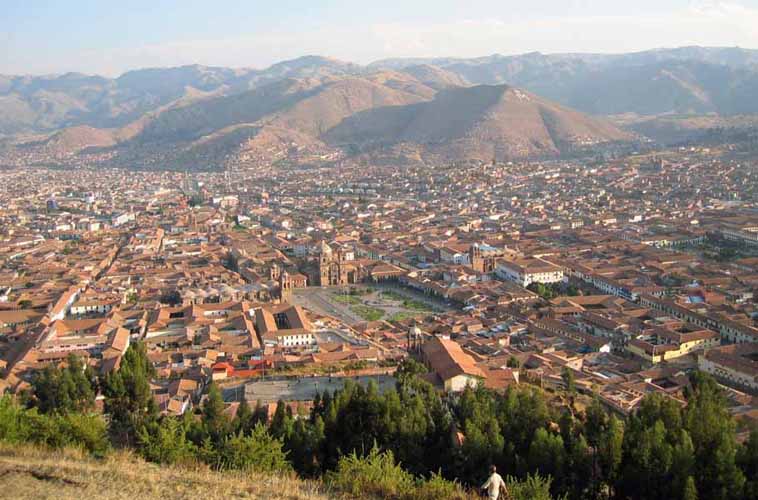
Lima is now the capital and it wasn’t always the case. I seem to recall that Lima was founded by the Spanish, but I will have to double check that. Cusco (below), inland in the Andes region of the country, as mentioned, was the Incan capital. The city has a population of 350,000. Outside of Cusco lies Machu Picchu, which I plan on describing in much detail after I have been there. Cusco’s sobriquet is the “navel of the earth,” implying some centrality in this spherical earth of ours. It occurs to me that this navel must be a rare “out-ty” as Cusco is 3,300 meters above sea level. Of course, even higher mountains surround the city so perhaps its nick-namers thought this bellybutton not to be freakish. I intend to find out.
Geographically Peru has 3 main regions, coastal desert, Andean highland and mountain, and Amazon jungle. This is the typical division, though I am told that Peru has one of the largest assortment of ecological zones of any country. I’m travelling during rainy season so the latter two regions will be affected, while the coast desert is always a dry hot. Cusco and Puno will be in the Andean highland region, while Manu or Tambopata, the jungle. The rest of my time after Puno will be spent in the coastal desert zone – however I am not sure that Colca Canyon will fit this category to a tee.
Another thing of note. I should hope to be in Puno by the first weeks of February. During this time “La Virgen de La Candelaria,” an annual festival, will be taking place. It is apparently a celebration of the city’s patron saint, fully equipped with song, dance, fireworks, plays, and parades. One of the more famous dances is called Diablada or Devil Dance, where dancers don horrifyingly ugly masks – I assume of a diabolical nature. If I were to choose beforehand a famous dance, I would probably pick one that appealed to the fertility gods, fully equipped with fit and scantily clad senoritas – but instead I’ll have to investigate the sensuality of devil-women. I don’t think it is going to be like our Halloween costumes, short red leather skirts, fishnets, and plastic horns.
I haven’t learned anymore Spanish. This could be a real problem. But I am excited to eat ceviche, the local sushi. It is apparently very popular – basically raw fresh fish in a bowl with spicy marinade of lemon juice, onion, and hot peppers. The Peruvian version of street meat – we’ll see how adventurous my stomach is! The cuisine is apparently incredibly varied, so again, more in-depth reporting to come.
I’ve got my Inca Trail hike booked, I’ll leave the 17th out of Cusco, which means I will have six days to get from Lima to Cusco by plane and get acclimatized to the elevation. Its 4 days 3 nights so I’ll be at the top of Machu Picchu at dawn on January 20th. After Cusco I am not sure if I’ll be visiting either Manu or Tambopata, which are both rainforest eco-tourism spots, just because of the rainy season/cost/ and travel difficulty. There are great high end eco-tourism packages for like a week in the jungle seeing all the animals, but they would cripple my ability to do anything for the rest of the trip. I could conceivably do a 3 day thing for like 200-400$ which would be much more affordable, but if it is going to rain all day and be impossible to see wildlife – monkeys, tapirs, caiman, parrots, even jaguars – there won’t be much point. Hopefully it is the case that a) during rainy season you can see all the wildlife (I have no idea either way) and b) during rainy reason they give big discounts on tours because tourists have to put up with rain. We’ll see.
Anyways I’ll be going to Puno either way after that, probably by train from Cusco. I did confirm that Lake Titacaca, the highest navigable lake in the world, is a major source for the Amazon system. Pictures of the lake look incredible and apparently you can rent a kayak for cheap. Awesome.
I’ve learned a bit about Peru which seems essential to enjoying the trip I’ll be going on. If you don’t like learning about the history/culture/facts of foreign lands this is the point at which you should cease reading.
Peru was inhabited by a multitude of different tribes all the way up until the 15th century or so. A diversity of tribes certainly existed afterwards, and up to this day, but the expansion of the Inca empire reduced this diversity significantly. In 10,000 BC floodplain agriculture marked the region’s entrance into the agricultural revolution (something that was happening simultaneously in places like the fertile crescent). What this means is that the region has known permanent human habitation for just as long as (or close to it at least) in the so called cradle of civilization. This isn’t too surprising of course, as the global climactic changes that created the window of opportunity for the agricultural revolution were, well, global.
During the period of 3000BC to 1800 village communities used river floodplains for cotton production, in addition to food – but relied mostly on fishing for sustenance. The production of cotton led to the development of considerable textile skill amongst these early communities. At the end of this period migration began inland as pottery developed. From there on cultures diversified and there are numerous tribes that developed productive and expansive civilizations. Hopefully I will be able to describe some in more detail a) while I am actually there visiting their ancestors or ruins etc b) when I know more about them.
 In the year 1438 (apparently we know this with great accuracy), the Inca tribe began rapid expansion. Incredibly rapid. In one hundred years the Incas controlled nearly the entire western coast of South America, which included parts of modern day Chile, Bolivia, Ecuador, and of course, Peru. What made this expansion (pictured) possible?
Incan administration was very well organized, despite not having any form of written language. They utilized a system of waypoints spread along the roads of their empire which were manned by ‘accountants’ who would keep precise track of the amount of goods travelling to and fro. These accountants used a counting system based on tying knots in string – called quipus. The number of knots was obviously important, but so was the spacing of knots, as well as the colour and structure of the string. From these waypoints there were also stationed runners, who would deliver communication between cities (or armies) at substantial speed for the period. Incan agriculture had a comparable advantage in efficiency over neighbouring tribes, creating large food surpluses, a precondition for the diversion of a society’s labour from agriculture to other efforts.
With these organizational advantages in hand the Incas set about conquering territory, but they had further techniques that aided them. They weren’t entirely fussy about the full conversion of other tribes’ religions and they were not interested in unnecessary bloodshed. It was often the case that the army would lie in wait outside of an enemy’s city while Incan diplomats negotiated terms of peaceful surrender. Once the Incan empire became powerful enough, this of course became more common.
What advantage they didn’t have was in weaponry – the Incas fought with wooden bow and arrow, and wooden spears. Metallurgy of any kind had not been discovered. This impediment in their development would end up costing them severely with the arrival of Spanish Conquistadors around 1532 – they didn’t just have metal swords, lances, armour, and helmets – they had gunpowder too. And horses. Did I mention the Incas neglected to invent the wheel as well? They were overwhelmingly handicapped.
Through the deception of supposed negotiations, the Inca Emperor of the time, Atahualpa, was captured by the Conquistadors shortly after their arrival. Cusco, the capital, was looted, and the empire was basically enslaved. The Incas had a taxation system based on physical labour – called mita – in that when a person came of a certain age they would travel to a larger city in the empire and serve the state for a few years before returning home, their debt to the empire paid. The Spanish exploited this system, transforming it into one of full-fledged slavery. Rebellions occurred, and much happened in between but Peruvian independence from European powers did not occur until after 1821.
I don’t know much about Peru’s modern history (yet) save that it has this strange characteristic amongst developing countries of supporting leaders who fucked up really badly in decades previous. The late Benazir Bhutto in Pakistan is of course an example, as is Jean-Bertrande Aristide in Haiti. The current President, Alan Garcia, nearly ran the country into the ground from 1985-1990, yet he reassumed office in 2006. While Bhutto’s death led to a general martyrdom in the western media it should be acknowledged that she was prime minister of Pakistan twice (!) previously 88-90 and 93-96, being removed from office both times on corruption charges. Her “exile” in Dubai in 1998 was self imposed. It just seems to me in countries with millions of people to choose from (29 million in Peru, 173 million in Pakistan) you might want to try someone new. I am not being entirely facetious.
Spanish of course, is a European import, and is often the second language of non-urban Peruvians (the first typically being Quechua, which I can tell you nothing about). In terms of architecture, Spanish influence, and indeed remnant, is considerable. How else this European influence manifests itself will be for me to discover.
Lima is now the capital and it wasn’t always the case. I seem to recall that Lima was founded by the Spanish, but I will have to double check that. Cusco (below), inland in the Andes region of the country, as mentioned, was the Incan capital. The city has a population of 350,000. Outside of Cusco lies Machu Picchu, which I plan on describing in much detail after I have been there. Cusco’s sobriquet is the “navel of the earth,” implying some centrality in this spherical earth of ours. It occurs to me that this navel must be a rare “out-ty” as Cusco is 3,300 meters above sea level. Of course, even higher mountains surround the city so perhaps its nick-namers thought this bellybutton not to be freakish. I intend to find out.
Geographically Peru has 3 main regions, coastal desert, Andean highland and mountain, and Amazon jungle. This is the typical division, though I am told that Peru has one of the largest assortment of ecological zones of any country. I’m travelling during rainy season so the latter two regions will be affected, while the coast desert is always a dry hot. Cusco and Puno will be in the Andean highland region, while Manu or Tambopata, the jungle. The rest of my time after Puno will be spent in the coastal desert zone – however I am not sure that Colca Canyon will fit this category to a tee.
Another thing of note. I should hope to be in Puno by the first weeks of February. During this time “La Virgen de La Candelaria,” an annual festival, will be taking place. It is apparently a celebration of the city’s patron saint, fully equipped with song, dance, fireworks, plays, and parades. One of the more famous dances is called Diablada or Devil Dance, where dancers don horrifyingly ugly masks – I assume of a diabolical nature. If I were to choose beforehand a famous dance, I would probably pick one that appealed to the fertility gods, fully equipped with fit and scantily clad senoritas – but instead I’ll have to investigate the sensuality of devil-women. I don’t think it is going to be like our Halloween costumes, short red leather skirts, fishnets, and plastic horns.
I haven’t learned anymore Spanish. This could be a real problem. But I am excited to eat ceviche, the local sushi. It is apparently very popular – basically raw fresh fish in a bowl with spicy marinade of lemon juice, onion, and hot peppers. The Peruvian version of street meat – we’ll see how adventurous my stomach is! The cuisine is apparently incredibly varied, so again, more in-depth reporting to come.

The chewing of Coca leaves is also legal in Peru, and undertaken to restore vitality, supposedly. Coca leaf tea is also popular. My guidebooks don't advise against it so I'm definitely going to try it out. I'm sure the subsquent blog entry could be incredibly anti-climactic or hilarious.
-- Gareth

No comments:
Post a Comment